
Magnetocardiography: An Emerging Frontier in Non-Invasive Detection of High-Risk Coronary Disease
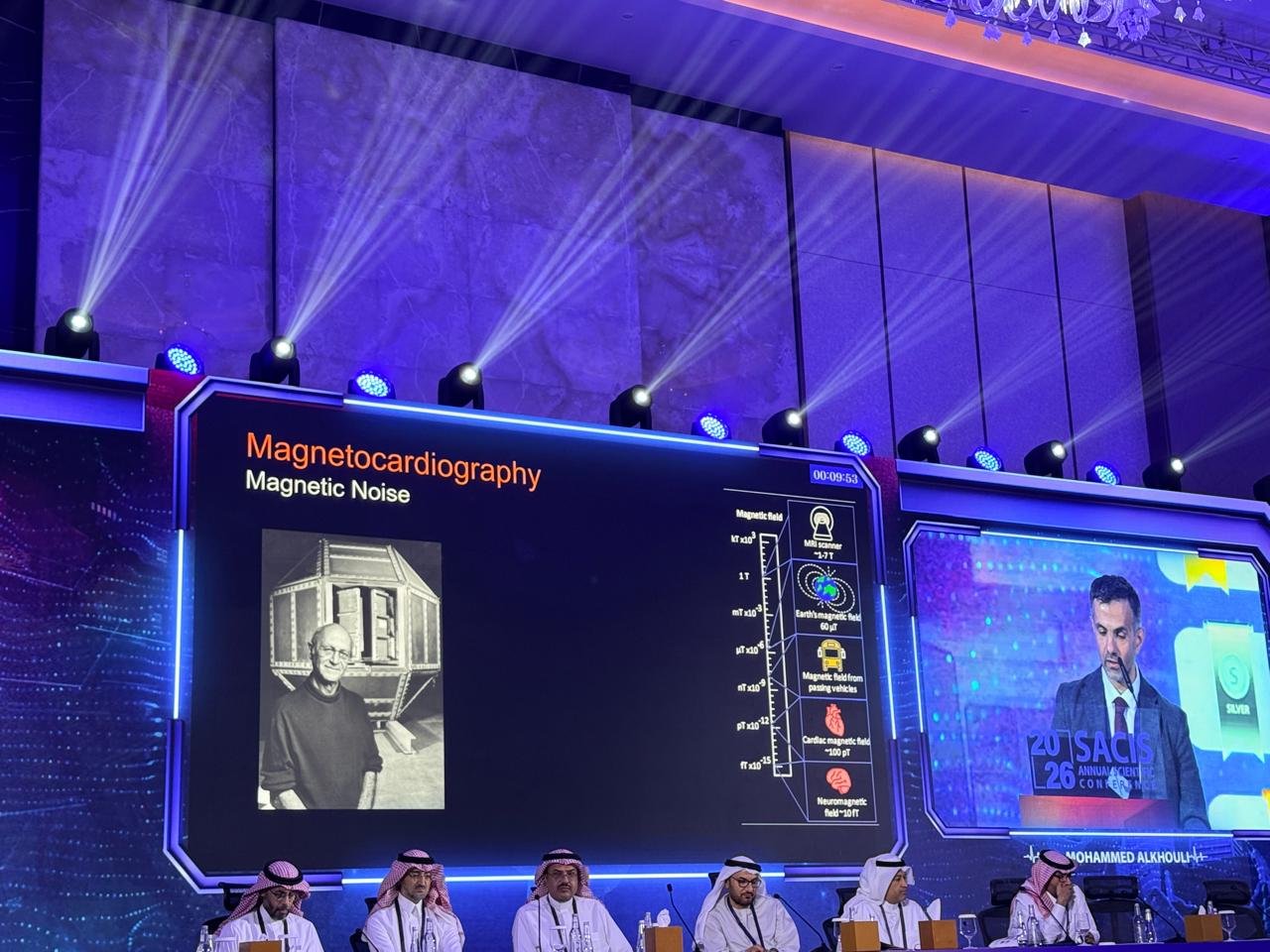
The lecture traced MCG's evolution from traditional SQUID-based technology, limited by the need for magnetic shielding, to newer unshielded systems that incorporate advanced signal processing and artificial intelligence.
Experimental studies at the Mayo Clinic MCG laboratory demonstrated that coronary occlusion produces measurable alterations in MCG patterns. These findings indicate that MCG may detect ischemia-related changes in myocardial electrical activity, particularly abnormalities in ventricular repolarization dynamics.
The authors presented a pilot study on occlusion myocardial infarction (OMI) involving 42 patients with non-ST-elevation myocardial infarction (NSTEMI), comparing MCG findings with coronary angiography. The MCG approach demonstrated 100% sensitivity, 96% specificity, 95% positive predictive value,and 98% negative predictive value for detecting total coronary occlusion. However, these promising results are preliminary due to the limited sample size.
Prof. Alkhouli also discussed the PRISM Study and integrating MCG with the CardiAQ artificial intelligence classifier, which analyzes MCG signals to help identify patients with high-risk coronary artery disease among those presenting with suspected non-ST-elevation acute coronary syndrome (NSTE-ACS).
The lecture emphasized a future direction in acute cardiac care that involves combining contactless MCG acquisition, advanced analytical techniques, and artificial intelligence to rapidly and noninvasively identify myocardial ischemia and high-risk coronary artery disease. Larger prospective studies are required to determine how this technology could complement electrocardiography (ECG), cardiac biomarkers, and coronary imaging in clinical practice.
Related link
Leroy, A, Maidens, J, Saleh, G. et al. 26-A-11614-ACC MACHINE LEARNING-BASED DETECTION OF CORONARY ARTERY DISEASE USING UNSHIELDED MAGNETOCARDIOGRAPHY. JACC. 2026 Apr, 87 (13_Supplement) A802. https://doi.org/10.1016/j.jacc.2026.02.2070